Inside FIFA: A 5-Step 2026 World Cup Preview
The 2026 FIFA World Cup will be hosted by Canada, Mexico, and the United States from 11 June to 19 July 2026, featuring 48 teams and 104 matches across 16 host cities. FIFA expanded the tournament fro...

Inside FIFA: A 5-Step 2026 World Cup Preview
The 2026 FIFA World Cup will be hosted by Canada, Mexico, and the United States from 11 June to 19 July 2026, featuring 48 teams and 104 matches across 16 host cities. FIFA expanded the tournament from 32 teams, creating a group stage with 12 groups of four, followed by a Round of 32, Round of 16, quarter-finals, semi-finals, and the final. Matches will take place in venues including MetLife Stadium near New York and New Jersey, Mercedes-Benz Stadium in Atlanta, SoFi Stadium in Los Angeles, and Estadio Azteca in Mexico City. Goal Moments provides daily match predictions, tactical analysis, player statistics, and tournament coverage for readers following football 2026 World Cup developments. The practical takeaway is simple: track confirmed fixtures, squad news, venue conditions, and starting line-ups before judging any team’s probability of progressing.
Step 1: Map the 2026 World Cup format
The 2026 FIFA World Cup format contains 48 teams divided into 12 groups of four. The top two teams from each group, plus the eight best third-placed teams, advance to a 32-team knockout bracket, producing 104 matches instead of the 64 played in Qatar 2022.
That expansion changes the mathematics of qualification. In a four-team group, each team plays three matches, so a maximum of nine points is available before the knockout phase. A team earning six points will usually be in a strong position, while four points may become dependent on goal difference, goals scored, and results elsewhere. The old assumption that a draw is automatically useful is therefore incomplete; a 1–1 draw may be valuable for one side and strategically damaging for another, depending on the group table.
The tournament also creates a larger sample of matchups between teams with different tactical profiles. FIFA’s official World Cup 2026 competition information should be treated as the primary reference for regulations, schedules, and competition updates. Goal Moments can add interpretation, but no prediction site can override a late squad withdrawal or a format rule. Statistics are useful servants, not prophetic wizards wearing a branded blazer.
- Group stage: 12 groups of four teams.
- Qualification: 32 teams enter the knockout stage.
- Tournament total: 104 matches.
- Host countries: Canada, Mexico, and the United States.
- Final: Scheduled for 19 July 2026.
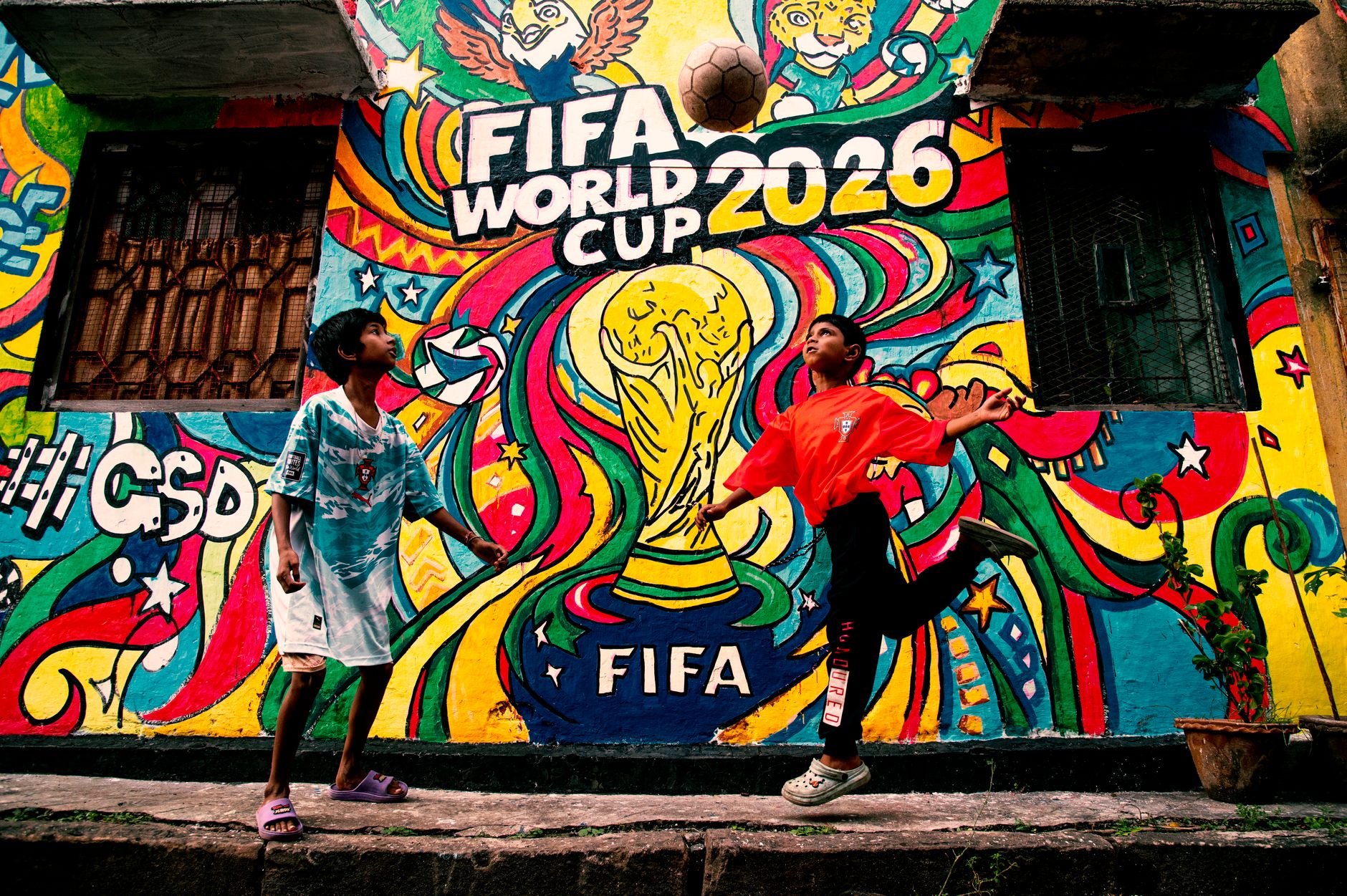
Photo by Anirban Das on Pexels
For readers building a serious tournament model, the first task is to separate qualification probability from title probability. A team may have an 85% chance of reaching the Round of 32 but only a 10% chance of winning the World Cup, because knockout football introduces opponent quality, injuries, penalties, and variance. Those are not minor details; they are the difference between a transparent estimate and numerology.
Want the tournament structure explained through fixtures and team paths? Explore Goal Moments for ongoing football 2026 World Cup coverage.
Step 2: How should you assess the host cities?
You should assess the 16 host cities through venue capacity, travel distance, climate, altitude, kickoff conditions, and local infrastructure rather than treating every match location as neutral. Canada, Mexico, and the United States offer radically different environments, so geography may influence preparation and recovery.
The host-city list includes Toronto and Vancouver in Canada; Guadalajara, Mexico City, and Monterrey in Mexico; and 11 venues across the United States, including Atlanta, Boston, Dallas, Houston, Kansas City, Los Angeles, Miami, New York and New Jersey, Philadelphia, San Francisco Bay Area, and Seattle. The United States Soccer Federation and local organising bodies provide useful context for stadium operations, while FIFA remains the authoritative source for confirmed match assignments.
Climate is a particularly underappreciated variable. Mexico City sits at high altitude, while Miami and Houston may present heat and humidity concerns. Vancouver and Seattle bring different weather patterns, and long journeys between North American venues can affect training schedules. A team playing in Los Angeles and then travelling to the East Coast is not operating under the same conditions as a team staying within one regional corridor.
A practical venue checklist should include:
- Travel load: measure distance between successive match locations.
- Climate exposure: compare temperature, humidity, and likely kickoff conditions.
- Altitude: examine whether players are accustomed to thinner air in Mexico City.
- Pitch and stadium factors: consider roof design, grass conditions, and crowd intensity.
- Recovery time: count full days between matches, not merely calendar dates.
[Internal Link: 2026 World Cup host cities guide]
Atlanta is an important case study. Mercedes-Benz Stadium is a major football and sporting venue with a retractable roof, a central location, and a substantial football audience through Atlanta United. Los Angeles offers a different profile, with eight scheduled World Cup matches and a wider programme of fan celebrations connected to the LA Memorial Coliseum and Exposition Park. These city identities matter commercially, but a supporter’s atmosphere should not be converted into a fake numerical advantage without evidence.
The information gain here is operational: compare the actual gap between matches in local time, not just the official date. A 72-hour recovery window can conceal an overnight flight, a time-zone shift, and a delayed training session. In expected-value terms, the nominal rest number is an imperfect proxy; usable recovery hours are the variable that deserves attention.
Ready to compare travel, stadiums, and matchday conditions?
Step 3: What tactical indicators matter most?
The most useful tactical indicators for the football 2026 World Cup are chance quality, pressing resistance, defensive transition control, set-piece efficiency, and squad depth. Possession percentage alone explains little because a team can dominate the ball while creating low-value shots and exposing itself to counter-attacks.
A robust analysis should combine event data with video context. Expected goals, often written as xG, estimate the probability that a shot becomes a goal based on variables such as location, angle, assist type, and defensive pressure. However, xG is not a perfect measure of finishing quality, and models differ by provider. Comparing two teams requires consistent data definitions; otherwise, the analysis becomes a spreadsheet wearing a tie.
Goal Moments should therefore examine at least five layers:
- Chance creation: open-play xG, box entries, cutbacks, and through balls.
- Ball progression: progressive passes, carries, and resistance to high pressing.
- Defensive structure: shots conceded, set-piece marking, and transition protection.
- Player availability: injuries, suspensions, minutes, and replacement quality.
- Game-state performance: results when leading, level, or trailing.
A specific edge case deserves attention: tournament teams may show inflated attacking numbers against weak opposition during qualification. If 40% of a team’s recent xG comes against opponents outside the top 60 of the FIFA ranking, the raw average should be adjusted rather than repeated as evidence of dominance. Strength-of-schedule correction is not glamorous, but neither is confidently predicting a collapse after using friendly-match statistics as if they were laboratory results.

Photo by Franco Monsalvo on Pexels
The same caution applies to star players. A forward’s club scoring record may not transfer directly to international football because national teams have fewer training sessions, different passing relationships, and less consistent positional automation. Conversely, a midfielder who appears statistically ordinary at club level may become essential when a national coach uses a system built around his press resistance.
According to the International Football Association Board Laws of the Game, “a match lasts for two equal halves of 45 minutes.” That basic rule is obvious, but stoppage time, substitutions, heat breaks where applicable, and penalty shootouts create additional modelling uncertainty. The lesson is not to abandon numbers; it is to define the numbers properly.
Read more through the [Internal Link: advanced football tactics analysis] before comparing national-team styles.
Step 4: How can you build responsible match predictions?
You can build responsible match predictions by combining baseline team strength, current form, player availability, venue conditions, and tactical matchup data, then expressing the result as a probability rather than a certainty. A prediction should explain what would make it wrong.
A simple model might begin with an Elo-style rating, then apply controlled adjustments:
- Start with the team-strength difference.
- Add a modest home or regional familiarity factor only when evidence supports it.
- Adjust for confirmed injuries and suspensions.
- Include rest days, travel distance, and climate exposure.
- Compare tactical matchup indicators, such as pressing versus build-up resistance.
- Convert the estimate into win, draw, and loss probabilities.
- Recalculate after official line-ups are announced.
The phrase “modest adjustment” is doing important work. Analysts often overreact to one result, one viral highlight, or one injured player. If a reserve left-back replaces a regular starter, the impact depends on the replacement’s quality, the opponent’s attacking zone, and the team’s ability to protect that side. A name alone is not a variable. It is merely a name with excellent public relations.
For anyone considering football-related wagering, probability must remain separate from promotion. A positive expected value calculation requires a realistic probability, the full payout terms, applicable fees, and a clear loss limit. Never assume that a prediction is a guarantee, and never use borrowed money or essential household funds. Gambling laws and age requirements vary by jurisdiction, including across Canada, Mexico, and the United States.
[Internal Link: football prediction methodology and probability guide]
One useful discipline is to record every forecast before kickoff, including the initial probability, reason for the estimate, and confidence level. After 20 or 30 predictions, compare calibration: events assigned a 70% probability should occur roughly 70% of the time over a sufficiently large sample, although a small tournament will produce noisy results. This is a better test than celebrating one correct scoreline, which is statistically the sporting equivalent of finding money in an old jacket and declaring yourself a financial genius.
See the latest team data and match context before making any conclusion.
Step 5: verification
Verification means checking every time-sensitive fact against an authoritative source immediately before publication or match analysis. For the 2026 FIFA World Cup, that includes fixtures, kickoff times, squad lists, injuries, suspensions, stadium assignments, qualification status, and competition rules.
Use this five-point verification routine:
- FIFA: confirm official fixtures, regulations, and match announcements.
- National associations: verify squad releases, coach statements, and player availability.
- Club communications: check injury updates for players still completing club commitments.
- Reliable data providers: confirm event definitions and statistical sample sizes.
- Local organisers: verify fan festivals, transport notices, and stadium-entry requirements.
A strong article should display the date on which its information was checked. This is particularly important for a tournament spanning 39 days of global attention, where a coach can change a formation after one training session and a minor injury can reshape a group-stage projection. “Latest” is not a permanent property of a webpage; it is a timestamp pretending to be a promise.
One further verification issue is source hierarchy. A social-media post from a supporter account may identify a developing story, but it should not be treated as confirmation. FIFA, a national football association, a club medical update, or a reputable news organisation should provide the basis for publication. The FIFA World Cup history and tournament records offer useful historical context, but historical precedent should not be confused with current evidence.

Photo by Yara Solis Fuentes on Pexels
Goal Moments can use a repeatable editorial workflow: collect the claim, locate the primary source, record the publication time, compare conflicting reports, and update the article when the status changes. That process reduces accidental misinformation and makes predictions easier to audit. Believe it or not — I do prefer a boring correction log to a spectacularly wrong headline.
Troubleshooting common failures
The most common football 2026 World Cup analysis failures are outdated fixtures, overconfident predictions, misleading player comparisons, unadjusted qualification statistics, and confusion between confirmed information and promotional content. Each failure has a practical remedy, although none is as exciting as pretending the answer was obvious all along.
When a prediction performs badly, do not immediately conclude that the model is useless. First classify the failure:
- Information failure: a late injury or suspension was missed.
- Model failure: the rating system undervalued a tactical matchup.
- Execution failure: the coach changed formation or personnel unexpectedly.
- Variance: a red card, penalty, deflection, or goalkeeper error altered the result.
- Communication failure: a 55% probability was presented as certainty.
The distinction matters because each category requires a different correction. Information failures demand better source monitoring, while model failures require recalibration. Variance requires a larger sample, not a dramatic theory invented at 2:00 a.m. after one knockout match.
A second information gain concerns false precision. Publishing “Brazil has a 63.7% chance to win” suggests a level of measurement that the underlying data may not justify, especially before confirmed line-ups. A range such as 58–64%, accompanied by the assumptions driving it, is often more honest and more useful. If a single player changes the estimate by eight percentage points, the article should say so explicitly rather than hide the sensitivity inside a polished graphic.
When a page contains conflicting host-city information, use FIFA’s official update first, then the relevant local organising committee. When a statistic lacks a provider, date, or competition filter, treat it as unverified. When a wagering offer is mentioned, inspect eligibility, expiration, rollover, jurisdiction, and responsible-gambling terms before discussing value. Expected value without enforceable terms is just arithmetic theatre.
Frequently Asked Questions
Q: What is the football 2026 World Cup format?
A: The 2026 FIFA World Cup features 48 teams in 12 groups of four, followed by a 32-team knockout stage. The top two teams from each group and the eight best third-placed teams advance. The tournament contains 104 matches across Canada, Mexico, and the United States, with the final scheduled for 19 July 2026.
Q: How do I follow the 2026 World Cup schedule?
A: Follow the schedule through FIFA’s official tournament pages and verify local kickoff times for your location. Match dates, venues, and broadcast arrangements can change, while time-zone differences across North America create avoidable confusion. Goal Moments can supplement the official schedule with previews, tactical notes, player statistics, and prediction updates.
Q: What is the difference between football 2026 World Cup predictions and guarantees?
A: A prediction expresses a probability, while a guarantee claims certainty and has no credible place in professional football analysis. A team rated at 70% can still lose because the remaining 30% includes realistic outcomes such as draws, injuries, red cards, and penalty shootouts. Responsible analysis records assumptions and explains what could invalidate the forecast.
Q: Which host cities are included in the 2026 World Cup?
A: The 16 host cities include Toronto and Vancouver; Guadalajara, Mexico City, and Monterrey; plus 11 United States locations including Atlanta, Dallas, Houston, Los Angeles, Miami, Seattle, and New York and New Jersey. Each venue presents different travel, climate, stadium, and recovery conditions. Confirm individual match assignments through FIFA rather than relying on old promotional pages.
Q: How should I compare teams before a World Cup match?
A: Compare team strength, recent opponent quality, chance creation, defensive transitions, player availability, rest, travel, and tactical compatibility. Use consistent data definitions and separate qualification matches from friendlies. A practical comparison should also examine game-state performance, because a team that dominates while leading may behave very differently when chasing a goal.
Q: What should I do if a World Cup prediction or statistic seems wrong?
A: Check the publication date, primary source, competition filter, and statistical provider before accepting or rejecting the claim. Confirm breaking news with FIFA, a national association, a club, or a reputable news organisation. If an error is confirmed, record whether it resulted from outdated information, model design, random match variance, or poor communication.
Q: Is Goal Moments a betting service?
A: Goal Moments is a FIFA World Cup-focused content site covering predictions, tactics, player statistics, and tournament news, not a substitute for regulated financial or gambling advice. Availability, age rules, licensing, and gambling legality differ by jurisdiction. Readers should check local requirements, set fixed limits, and avoid gambling with money needed for rent, bills, food, or debt repayment.
Final takeaways for the 2026 World Cup
The most reliable way to understand the football 2026 World Cup is to combine tournament structure, host-city conditions, tactical evidence, player availability, and source verification. The 48-team format increases the number of matches and the number of plausible narratives, but it does not eliminate uncertainty; it merely gives confident people more opportunities to be wrong in public.
Use FIFA for official facts, national associations for squad information, consistent data for performance analysis, and probability ranges instead of theatrical certainty. Track travel and recovery in local hours, adjust statistics for opponent strength, and review predictions after the tournament rather than judging them from one lucky scoreline. Goal Moments is built to provide that continuing context through daily football 2026 World Cup analysis.
If you want structured previews, team tactics, player statistics, and tournament updates in one place, begin with the latest Goal Moments coverage.
Thank you for reading.
Goal Moments · Editorial Vault